
About 540 million years ago, in a geological blink, life stopped being a world of simple blobs and erupted into almost every body plan we still see today. Eyes, shells, jaws, limbs, spines, the first real predators and the first real armor; most of the great branches of the animal kingdom show up, all at once, in the fossil record. Biologists call it the Cambrian explosion, and it’s the canonical example of what happens when some new opportunity opens up and evolution rushes in to fill every corner of it. It’s exactly the burst of variety I expected from interactive video but didn’t get.
I’ve been reading up on the history of online meetings and interactive video, and the thing that stuck with me wasn’t any particular product. It was the shape of the whole arc. Technologies tend to move through a stretch of creativity and experimentation and then settle into stasis, sometimes into something closer to petrification. HTML did it, ecommerce did it, mobile did it. Actually, online communication did it too. After a pile of competing ideas about what being online even meant, it all narrowed down.
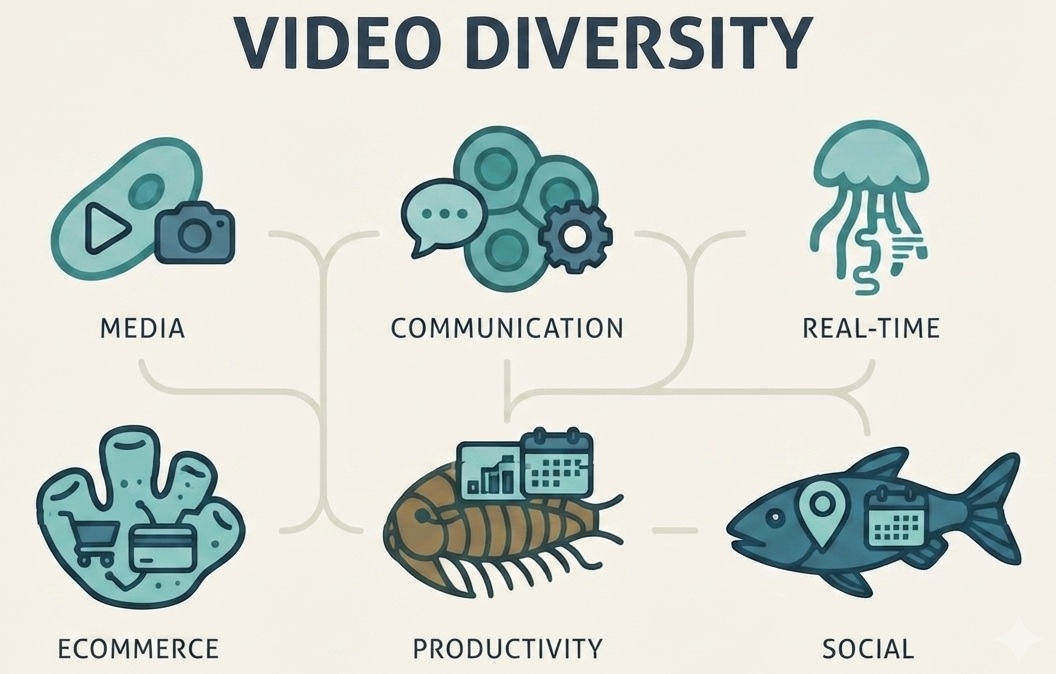
Interactive video collapsed into a single form
Interactive video is the specific case that struck me most, because the narrowing was so complete. When WebRTC landed in every browser, remote visual communication became essentially frictionless for everyone and essentially free for one-on-one connections. That’s the sort of moment where you’d expect a lot of people to try a lot of things. And the things they could have tried aren’t hard to list: ambient video for remote coworkers, interactive customer support, a remote café where you can see and hear the tables near you, an always-on window to your family on the other side of the world, live portals between two cities, apps built specifically for dates, tools tuned for pair programming, easy vet visits, real-time sales calls, someone to help you in an online store the way someone would in a physical one. Instead we got FaceTime, and Zoom, and Zoom clones.
Some convergence is completely normal, and even good. Tools for communication and for comfortable living tend to settle on a familiar experience — partly for safety, partly for standardization, partly because people just want the thing to work the way they expect. Cars settled into a fairly narrow set of controls. Furniture settled too. But “settled” doesn’t mean “one.” A chair in a car isn’t a chair in a kitchen isn’t a chair in a living room, and each got optimized for what it’s actually for. Even cars keep branching by purpose; a pickup and a sports car and a Prius barely look related. Convergence in a healthy category still leaves you with a family of forms. Interactive video skipped that part. It converged on a single form and mostly stayed there.
The pandemic locked in the grid meeting
The pandemic is the chapter everyone remembers, and on paper it should have been the trigger. Overnight, millions of people who had never used remote video were using it every day. If you were going to get an explosion of new idioms, that was the moment. We had a captive, motivated, suddenly fluent audience. What actually happened is that everyone reached for the same scheduled grid meeting, over and over, on Zoom or Google Meet.
I’ve come around to thinking the suddenness is a big part of why. A slow rollout gives people room to experiment, to develop dialects, to notice that different situations want different tools. A shock does the opposite. Nobody had the spare attention to talk their coworkers or their family into some domain-specific app; everyone was already learning fifty other new pandemic rules at once. One standard you could learn once and then stop thinking about was a relief, not a limitation. The tools for that standard already existed, and the companies behind them were poised to scale. So the mental model of “interactive video” froze into a single picture at exactly the moment the most people were forming it for the first time.
You can’t adopt a new idiom alone
It reminds me a little of QWERTY. The keyboard layout is probably not optimal, but it was good enough and it locked in, and part of why it locked in is that keyboards were shared. Asking everyone around you to learn your clever new layout isn’t a gift, it’s an imposition. Video has the same property. A better idiom that only pays off if the person on the other end also adopts it is a hard sell, especially when the boring default already works fine for both of you.
There’s a version of this I think about with the web itself. A huge share of the people who came online in the 2000s met the web through Facebook, and a lot of them never saw the strange, creative, wildly varied web that existed alongside it (and, kind of, still does.) Their sense of what a web page even is got quietly set to the Facebook version. Facebook was, in its way, a throwback to AOL in the ’90s: a walled, curated, lowest-common-denominator experience that plenty of people mistook for the whole internet. Zoom is doing something similar to interactive video. For most people it simply is interactive video, and it’s hard to miss a possibility you were never shown.
Circumstance, corporations, and habit pushed one way
So WebRTC could have been to interactive video what HTML was to publishing: a cheap, universal substrate that lets a thousand forms grow. It didn’t turn out that way. Circumstance (the timing of the pandemic), corporate standardization (the players who happened to be ready to scale), and ordinary human nature (limited attention, the cost of imposing new habits on other people) all pushed the same direction at the same time. In an ecosystem that could have supported a lot of variety, one species took the whole niche. Getting the variety back won’t happen on its own; it takes some deliberate cultivation of the odd, specialized cases.
Those of us who keep arguing for the non-Zoom versions of video sometimes feel like the neighbor who tears out the front lawn and puts in native plants, or a rock garden, or terraced wildflowers. Some people walk by and like it. Some think it’s a little kooky. Some genuinely dislike it. All three reactions are fine, and none of them tell you much about whether it was a good idea.
The companies with the most to gain didn’t build it
The part I find particularly ironic is who lost the most here. The companies with the most to gain needed really good remote tools: better onboarding, remote mentoring, group idea generation, ambient presence, the serendipitous run-ins that offices are supposed to be good at. They mostly didn’t build or adopt them. A lot of them looked at the gaps in the tools they did have and concluded that remote work itself was the problem. That’s a strange inference. There’s reasonable evidence that companies can be more productive, and more attractive to work for, when they actually commit to remote-first and treat the missing pieces as problems to solve instead of proof that the whole idea is broken. Blaming the medium was easier than inventing in it.
Here’s a smaller one I still can’t fully explain. Physical stores keep live greeters and salespeople around, and that model has survived a very long time. Online retail has almost none of it; live help while you shop is nearly nonexistent. One reading is that customers never actually liked being approached, and shopping online finally lets them decline it politely. Maybe. But if that were the whole story, I’d have expected at least a wave of attempts that people then rejected, and I don’t really see even that. My better guess is that online retail never standardized the idea that a store can notice you’re there at all, so real-time greeting never got a fair shot. The custom may have been rejected before there was ever a tool to try it with.
The tools to rebuild the variety exist now
None of this is a dead end, though. The layer that was missing is showing up. Tools like LiveKit, Daily, and VibeLive sit on top of WebRTC and let you build for the situation first, with the video shaped to fit, rather than forcing every interaction into a meeting. Want always-on ambient video? That’s supported. Want mixed media with custom filters and shared data inside the call? Supported. Want a website that keeps its own list of who’s around and matches people up on the fly? Want programmers to open dedicated streams to share their testing tools? All of that is buildable now, and it’s cheap, and, with vibe-coding it isn’t especially hard. That part is new and exciting.
And the companies aren’t all closed to it. Plenty are open to trying something that isn’t a grid of faces, as long as someone shows them a version that clearly beats the meeting for their particular case. What’s missing isn’t capability, and it isn’t willingness. It’s a handful of breakout examples, a few applications that work well enough, and specifically enough, that people start to see interactive video as something you build with rather than something you schedule. I think those are within reach. Mostly it’s a matter of someone bothering to plant something other than lawn.